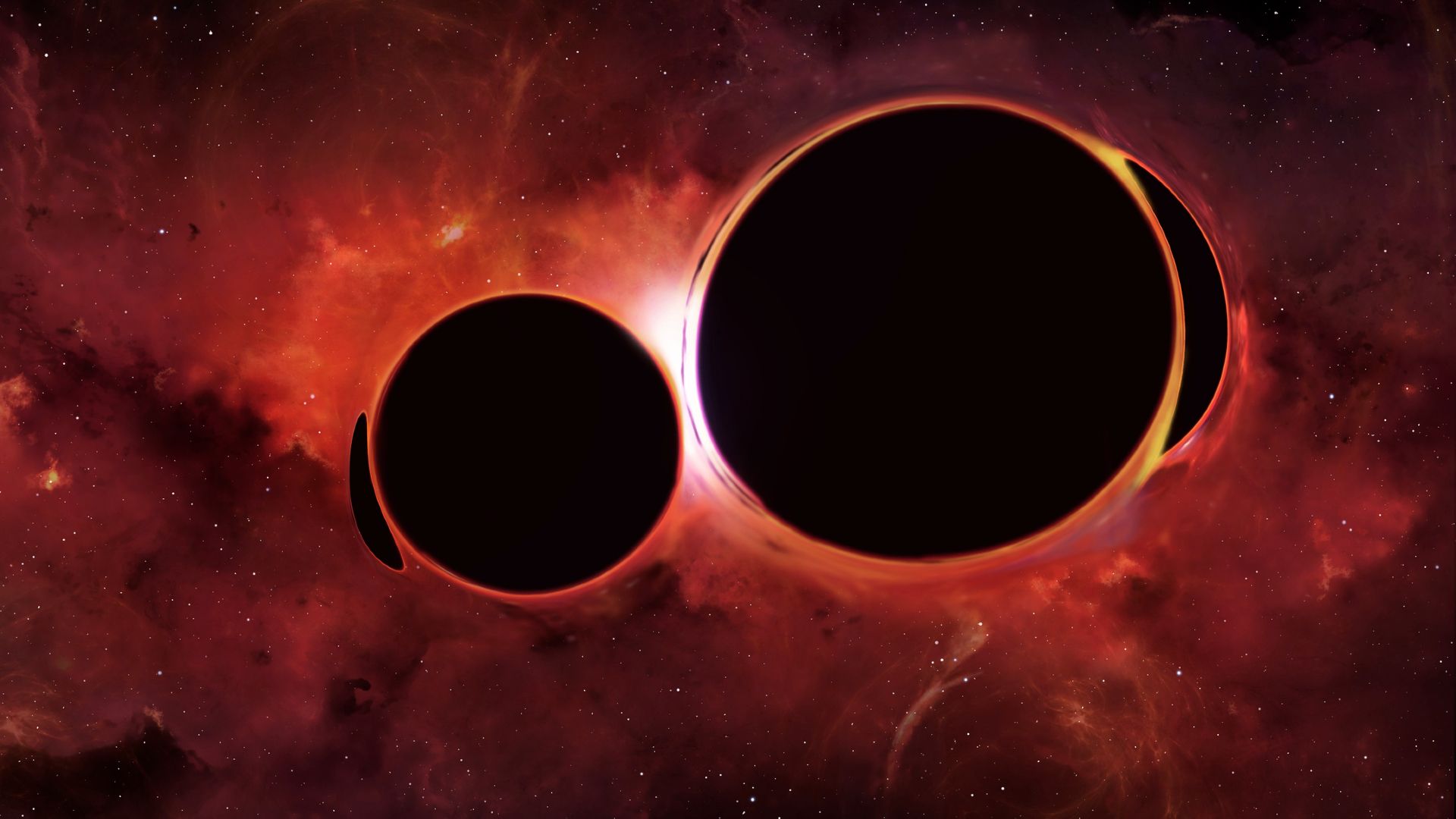
Two Supermassive Black Holes on Collision Course Could Send Gravitational Waves to Earth Within a Century
In a galaxy 500 million light-years away, two supermassive black holes could merge, spreading gravitational waves across the universe.
Astronomers have identified a pair of supermassive black holes in a galaxy approximately 500 million light-years from Earth that may be on a catastrophic collision course, with the merger potentially occurring within the next 100 years — a cosmic blink of an eye in astronomical terms.
The two massive objects, each believed to contain millions or even billions of times the mass of our Sun, are locked in a tightening gravitational dance at the center of their host galaxy. Scientists say the pair has been drawing closer for millions of years, but the final merger could now be imminent by astronomical standards.
When the collision occurs, it is expected to unleash an extraordinary burst of gravitational waves — ripples in the fabric of spacetime first predicted by Albert Einstein in his general theory of relativity. These waves would radiate outward across the universe at the speed of light, eventually washing over Earth with detectable force.
While no physical danger is posed to our planet, the gravitational wave signal from such a merger would be among the most powerful ever detected. Scientists believe pulsar timing arrays — networks of ultra-precise millisecond pulsars scattered across the galaxy — could pick up the low-frequency waves produced by such a colossal event.
The discovery adds critical real-world data to scientists' understanding of the so-called 'final parsec problem,' a long-standing theoretical puzzle about how two black holes ever get close enough to actually merge, since gravitational interactions with surrounding stars and gas clouds should slow their approach.
Researchers are calling the system one of the most promising candidates ever found for an imminent supermassive black hole merger. Continued monitoring using radio telescopes and gravitational wave observatories will allow astronomers to refine their timeline and better prepare detection instruments for the event.
The find underscores the rapid advances being made in multi-messenger astronomy, where light, radio waves, and gravitational waves are used in concert to unravel the universe's most violent phenomena. For scientists, the potential merger represents a once-in-a-generation opportunity to witness and measure one of nature's grandest spectacles.