How the Brain's Command Structure Reshapes Itself From Birth to Old Age
fMRI data from individuals of a wide range of ages (from a few days to 100 years old) are used to map the key organizational axes of functional connectivity in the human cortex throughout the lifespan.
Functional Hierarchy of the Human Neocortex Across the Lifespan
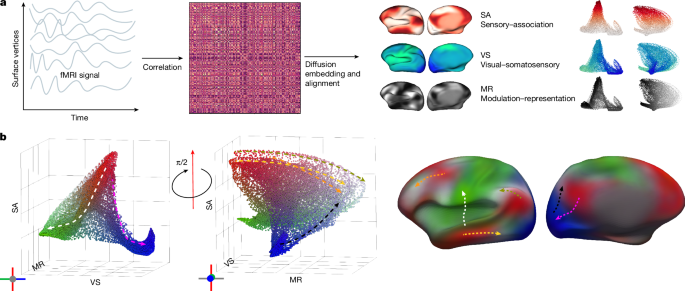
A groundbreaking new study has mapped the fundamental organizational principles of functional connectivity in the human brain from birth to old age, revealing how the cortical hierarchy develops, matures, and changes over the course of a century of life. Using functional magnetic resonance imaging (fMRI) data collected from individuals ranging from just a few days old to 100 years of age, researchers have produced the most comprehensive picture yet of how the brain's functional architecture transforms across the entire human lifespan. The findings shed new light on the key axes along which the neocortex is organized and how these axes shift in prominence and configuration as the brain grows and ages.
The research team analyzed resting-state fMRI data to identify the principal gradients of functional connectivity that define how different cortical regions relate to one another. These gradients capture a hierarchical organization ranging from primary sensory and motor areas to higher-order association regions involved in abstract thought, memory, and complex decision-making. The study found that this sensory-to-association hierarchy is not static but undergoes dramatic remodeling throughout life, with the most rapid changes occurring during infancy and early childhood as the brain establishes its foundational connectivity patterns.
During development, the researchers observed a progressive differentiation of the cortical hierarchy, with association cortices becoming increasingly distinct from sensory regions as children grow into adolescence and young adulthood. This expansion of the functional gradient aligns with the well-documented maturation of higher cognitive abilities during these periods. In contrast, aging was associated with a gradual compression and dedifferentiation of the cortical hierarchy, with the boundaries between sensory and association networks becoming less distinct in older adults. This pattern may help explain the cognitive decline commonly observed in later life, as the brain's functional organization becomes less specialized.
The study represents a major advance in understanding the lifespan trajectory of brain organization and offers a valuable reference framework for future research into neurodevelopmental and neurodegenerative conditions. By establishing normative patterns of cortical hierarchy across all stages of life, the findings could aid in identifying individuals whose brain development or aging deviates from typical trajectories, potentially enabling earlier detection of disorders such as autism, schizophrenia, or Alzheimer's disease. The researchers noted that their work underscores the dynamic nature of brain organization and highlights the importance of considering age as a critical variable in any study of human brain function.