All Five DNA Building Blocks Found in Asteroid Ryugu
Samples returned from the asteroid Ryugu contain all five canonical nucleobases (A, G, C, T and U). Their presence in Ryugu and Bennu supports the hypothesis that carbonaceous asteroids contributed to the prebiotic chemical inventory of early Earth.
Complete Set of Life's Building Blocks Discovered in Asteroid Ryugu Samples
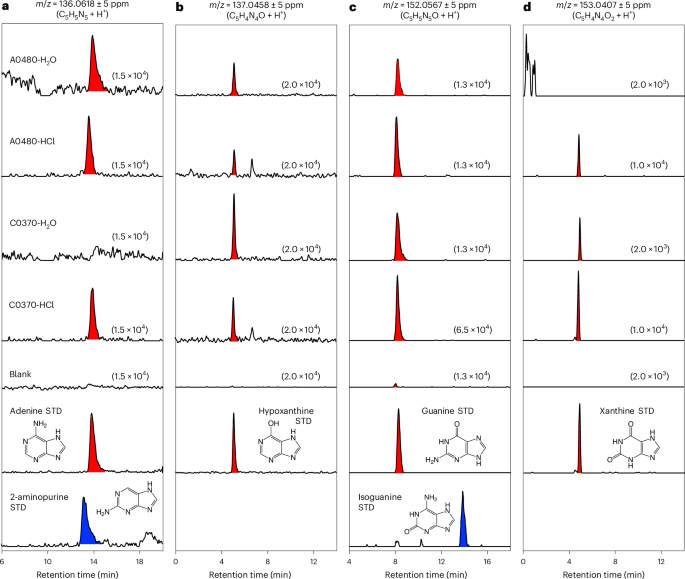
Scientists have confirmed the presence of all five canonical nucleobases in samples returned from the carbonaceous asteroid Ryugu, marking a landmark discovery in our understanding of how the essential ingredients for life may have arrived on early Earth. The nucleobases adenine, guanine, cytosine, thymine, and uracil, which form the fundamental coding components of DNA and RNA, were identified in material collected from the near-Earth asteroid designated (162173) Ryugu. This finding represents the first time a complete set of these biological building blocks has been detected in pristine extraterrestrial samples that were collected directly from an asteroid and returned to Earth under controlled conditions.
The discovery holds particular significance because the samples from Ryugu were collected in the vacuum of space and sealed to prevent terrestrial contamination, a persistent concern that has plagued studies of nucleobases found in meteorites that have landed on Earth. Previous analyses of carbonaceous meteorites had detected some nucleobases, but questions always remained about whether those organic molecules were truly extraterrestrial in origin or the result of contamination after the space rocks entered Earth's environment. The Ryugu samples, delivered to Earth by Japan's Hayabusa2 mission, effectively eliminate this uncertainty and provide the strongest evidence yet that these molecules can form in space.
The findings are further bolstered by complementary research on samples from the asteroid Bennu, collected by NASA's OSIRIS-REx mission, which has also revealed the presence of nucleobases and other organic compounds. The detection of these critical molecules on two separate carbonaceous asteroids suggests that the formation of nucleobases in space is not a rare or isolated phenomenon but rather a widespread process occurring on carbon-rich celestial bodies throughout the solar system.
These results lend powerful support to the long-standing hypothesis that carbonaceous asteroids played a key role in delivering prebiotic organic molecules to early Earth, potentially seeding our planet with the chemical raw materials necessary for the emergence of life. During the Late Heavy Bombardment period approximately four billion years ago, Earth was subjected to intense asteroid impacts that could have deposited vast quantities of organic compounds on the planet's surface. The confirmation that asteroids like Ryugu and Bennu carry a full complement of nucleobases strengthens the case that the origins of life on Earth may be intimately connected to the delivery of materials from space, opening new avenues of research into how chemistry in the cosmos set the stage for biology on our world.