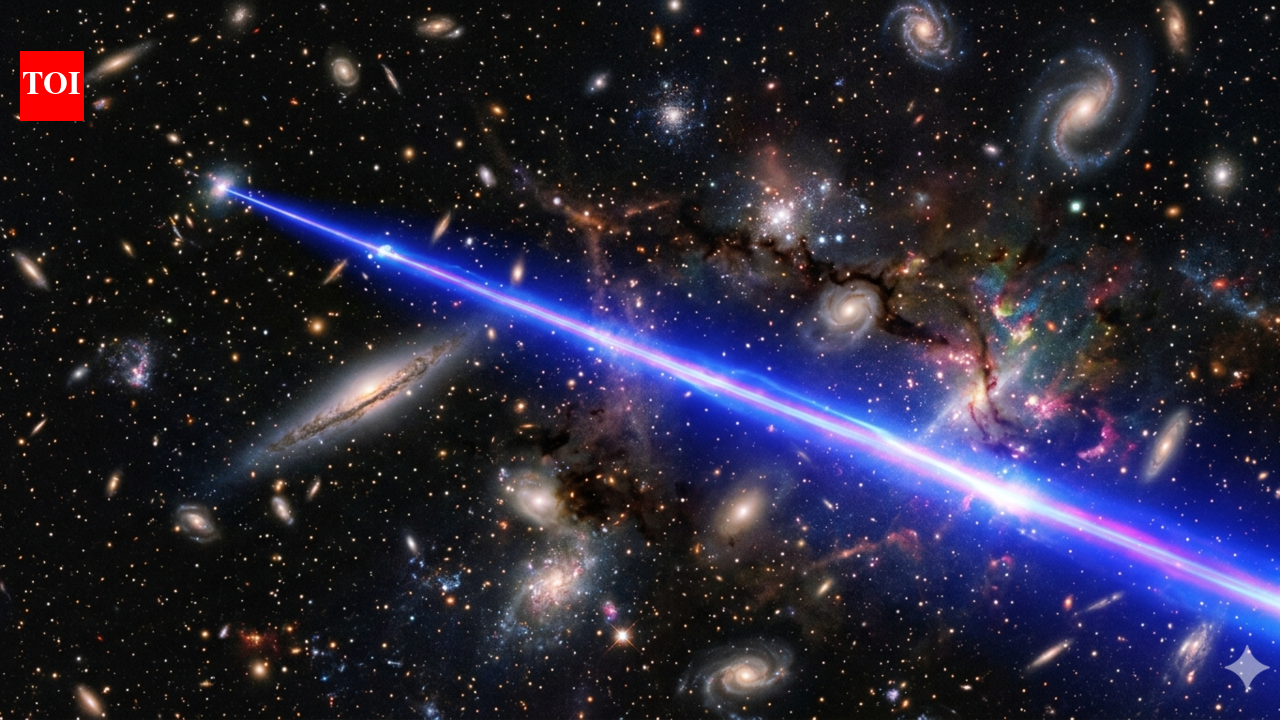
Astronomers Detect Powerful Mega-Laser Signal From 8 Billion Light-Years Away
Science News: One of the most remarkable discoveries made by astronomers in recent years is the identification of an extremely strong \"mega-laser\" signal that has t.
Astronomers have made one of the most extraordinary discoveries in recent memory, detecting an exceptionally powerful 'mega-laser' signal originating from a staggering 8 billion light-years away from Earth. The finding has sent ripples through the scientific community and is being hailed as a landmark moment in deep-space observation.
The signal, classified as a megamaser, is produced when certain molecules in space are energized to emit an intense, highly focused beam of microwave radiation. Unlike conventional lasers that operate with visible light, megamasers work on microwave frequencies and are generated by some of the most energetic events in the universe, such as galaxy collisions.
The detected megamaser is believed to be the most distant of its kind ever recorded, surpassing previous records by a significant margin. Scientists say the signal traveled for approximately 8 billion years before reaching Earth, meaning it originated when the universe was roughly half its current age.
Researchers identified the signal using the MeerKAT radio telescope in South Africa, one of the most sensitive radio telescopes in the world. The telescope's advanced capabilities allowed scientists to pick up the faint but distinctive signature of the megamaser amid the vast noise of the cosmos.
The discovery suggests that violent galactic mergers were far more common in the earlier universe, providing scientists with a unique window into the formative processes that shaped galaxies across cosmic history. Each megamaser event is typically triggered when two galaxies collide, compressing vast clouds of gas and triggering an intense burst of radiation.
Scientists are now analyzing the data further to understand the physical conditions that gave rise to such an extreme signal over such an enormous distance. The findings are expected to be published in a peer-reviewed journal and could reshape our understanding of galactic evolution and the large-scale structure of the universe.