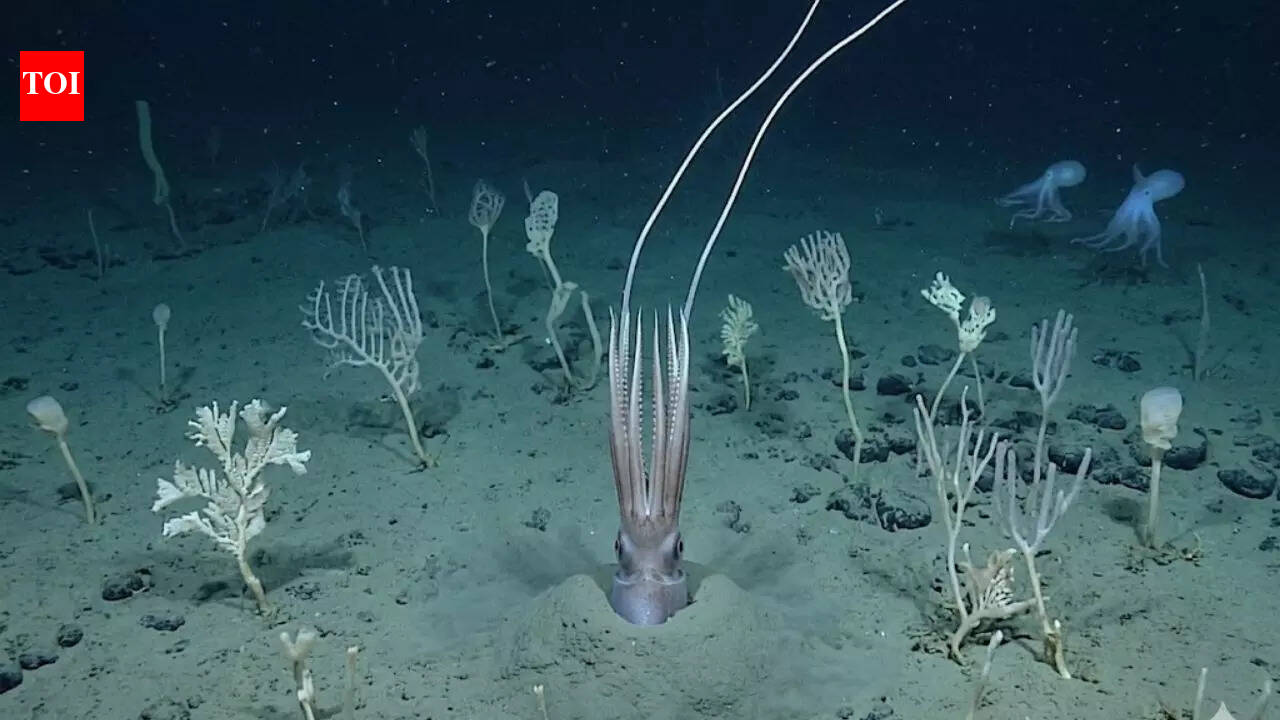
Deep-Sea Squid Transforms Into Tree-Like Shape 4 Kilometres Below the Pacific
Science News: The new finding, made by researchers in a new era for marine biology, is the first such discovery of footage of an undescribed species of whiplash squ.
Scientists film deep-sea squid 'turning into a tree' 4 kilometres below the Pacific
An international team of marine biologists has captured extraordinary footage of a previously undescribed species of whiplash squid transforming its body into a striking tree-like posture nearly four kilometres beneath the surface of the Pacific Ocean. The remarkable video, recorded by a remotely operated underwater vehicle during a deep-sea expedition, shows the squid extending its elongated tentacles and arms outward in rigid, branch-like formations, creating a silhouette that bears an uncanny resemblance to a bare winter tree. Researchers say the discovery marks a significant milestone in our understanding of deep-ocean cephalopods.
The footage represents the first time scientists have documented this particular species on camera, and the unusual posture has never before been observed in any known squid species. Experts believe the tree-like stance may serve as either a feeding strategy, allowing the squid to maximise the surface area of its tentacles to capture passing prey and marine snow, or as a defensive mechanism designed to confuse or intimidate potential predators in the pitch-black depths. The squid held the extraordinary pose for several minutes before retracting its limbs and jetting away into the darkness.
The discovery comes during what many marine biologists are describing as a new era for deep-sea research, driven by rapid advances in underwater robotics, high-definition imaging technology, and artificial intelligence-assisted species identification. Scientists estimate that the vast majority of deep-ocean species remain undiscovered, and expeditions like this one are increasingly revealing creatures and behaviours that challenge existing assumptions about life in the abyss. The research team is now working to formally describe and classify the new species based on the video evidence and environmental data collected during the dive.
Lead researchers on the project said the finding underscores just how little humanity knows about the deepest parts of the ocean and called for expanded investment in deep-sea exploration. They noted that with mounting threats from deep-sea mining, climate change, and ocean acidification, documenting these fragile ecosystems and their inhabitants has taken on new urgency. The team plans to return to the same region of the Pacific in the coming months, hoping to capture additional footage and potentially collect specimens that would allow for a complete scientific description of the enigmatic squid.