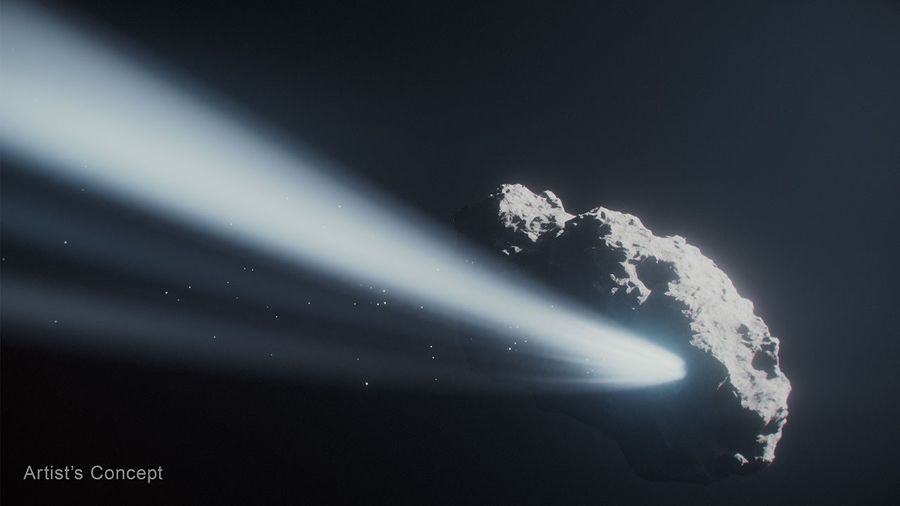
Doomed Comet Caught Spinning Backward in Hubble Observations
The fast rotation will lead to centrifugal forces that spin the comet apart: "I expect this nucleus will very quickly self-destruct."
Hitting the brakes: Hubble Space Telescope watches doomed comet reverse its spin
NASA's Hubble Space Telescope has captured a rare and dramatic phenomenon unfolding in our solar system: a comet that is rapidly changing its rotational direction, a process that scientists say will ultimately lead to its complete destruction. The comet, which has been under close observation by astronomers using the iconic orbiting telescope, is experiencing torques from jets of gas and dust erupting from its surface as it approaches the sun. These outgassing events have been powerful enough to slow the comet's spin and begin reversing it entirely, marking one of the few times such a rotational shift has been directly observed in real time.
The reversal in spin is far more than a cosmic curiosity. As the comet's rotation accelerates in its new direction, centrifugal forces acting on the loosely bound body of ice and rock are expected to intensify dramatically. Comets are fragile objects held together by relatively weak gravitational and structural forces, and the increasing rotational speed could easily exceed the threshold needed to keep the nucleus intact. Researchers studying the data from Hubble have concluded that the comet is on an irreversible path toward disintegration.
"I expect this nucleus will very quickly self-destruct," said the lead researcher on the observation team, noting that the speed at which the rotation is changing leaves little hope for the comet's survival. The scientist explained that as sunlight heats the comet's surface unevenly, jets of vaporized material act like small thrusters, exerting asymmetric forces that can dramatically alter its spin state. Once the rotation reaches a critical rate, the comet will simply fly apart, scattering debris along its orbital path.
The observation represents an important scientific opportunity, as witnessing a comet in the final stages before its breakup allows astronomers to learn more about the internal structure and composition of these ancient objects. Comets are considered pristine remnants from the early solar system, and understanding how they come apart can reveal details about the materials that existed billions of years ago when the planets were still forming. The Hubble team plans to continue monitoring the doomed comet for as long as it remains observable, hoping to capture the moment of its ultimate demise.