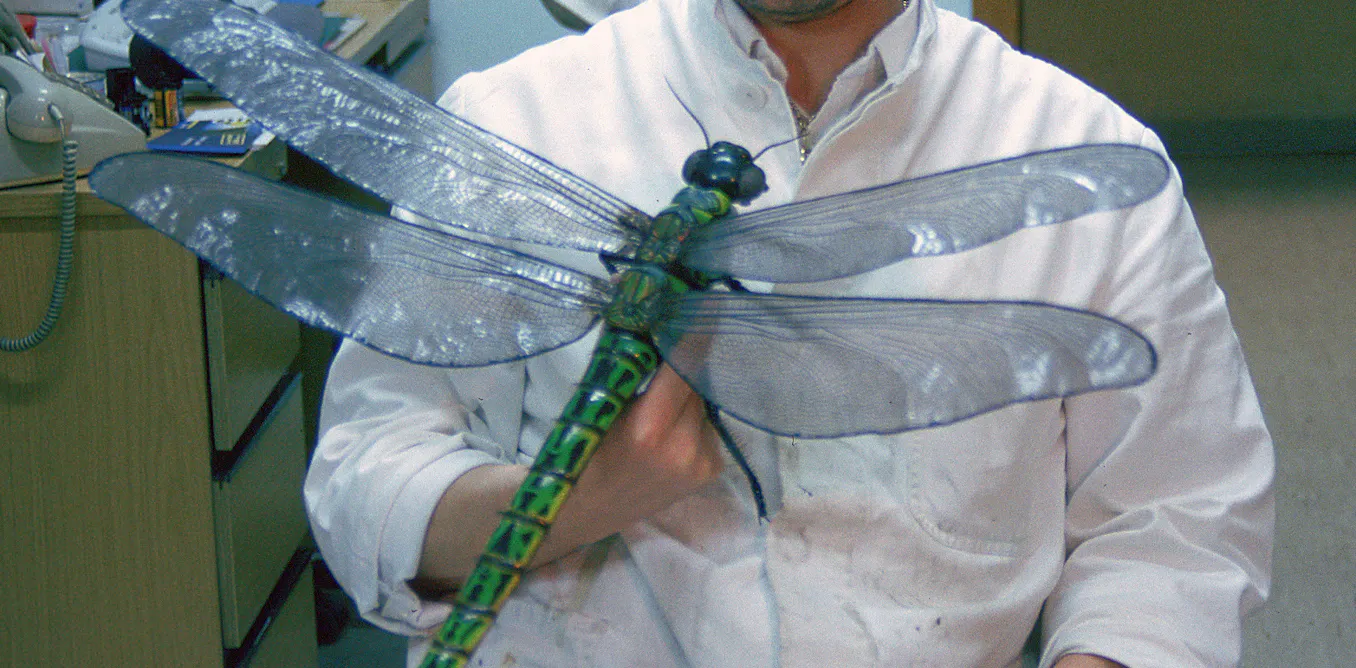
Giant Dragonflies Once Ruled the Skies — New Research Shatters the Leading Theory Behind Their Disappearance
Scientists thought giant dragonflies couldn’t survive in today’s atmosphere – but a study of dozens of insect species shows that’s not the case.
Giant dragonflies once roamed Earth's skies. New research upends the textbook theory of why they went extinct.
For decades, scientists have pointed to changes in atmospheric oxygen levels as the primary reason ancient giant dragonflies, known as Meganeuropsis, disappeared from Earth's skies. These massive insects, which boasted wingspans of nearly two and a half feet, thrived during the Carboniferous period roughly 300 million years ago when oxygen concentrations reached approximately 35 percent, far higher than today's 21 percent. The prevailing theory held that as oxygen levels declined, these oversized insects could no longer absorb enough of the gas through their tracheal breathing systems to sustain their enormous bodies. It was a tidy explanation that found its way into biology textbooks around the world.
Now, a sweeping new study is challenging that long-accepted narrative. Researchers examined the respiratory systems and oxygen tolerance of dozens of modern insect species across a wide range of body sizes. Their findings revealed that insects, including modern dragonflies, are far more adaptable to varying oxygen levels than previously believed. Even at today's atmospheric oxygen concentrations, the data suggest that the respiratory anatomy of insects could theoretically support bodies much larger than any living species. In short, low oxygen alone cannot explain why giant dragonflies vanished.
So what did drive these ancient aerial giants to extinction? The researchers propose that other ecological pressures likely played a far greater role. The rise of early birds and other flying vertebrates during the Mesozoic era would have introduced fierce competition for airspace and prey, while also turning the giant dragonflies themselves into tempting targets. Shifts in habitat, climate fluctuations, and changes in available food sources may have compounded these pressures. The study suggests that a combination of predation and competition, rather than a single atmospheric factor, sealed the fate of these remarkable creatures.
The findings, published this week in a leading biology journal, have already sparked discussion among entomologists and paleontologists who say the research forces a significant rethinking of how body size evolves in insects. While the oxygen hypothesis is unlikely to disappear from textbooks overnight, scientists say this work opens the door to a more nuanced understanding of what shapes and limits life on Earth. It also serves as a reminder that even the most established scientific explanations can be upended when researchers take a closer, more rigorous look at the evidence.