Giant Insects Could Have Grown Even Bigger — Oxygen Wasn't the Limiting Factor
New evidence suggests that diffusive oxygen transport through the tracheolar–muscle system is not the limiting factor on insect body size.
Oxygen supply through the tracheolar–muscle system does not constrain insect gigantism
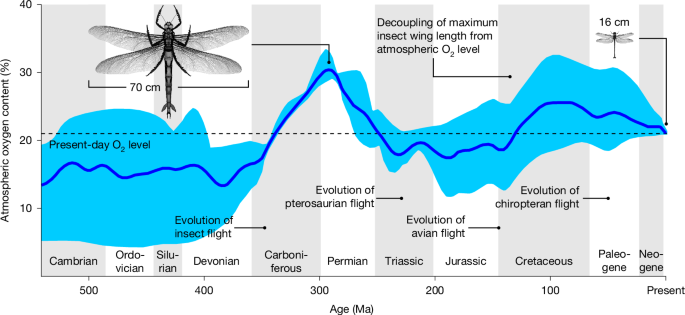
For decades, scientists have widely accepted the hypothesis that the insect tracheal system places a fundamental constraint on how large insects can grow. The prevailing theory held that as insects increase in body size, the diffusion of oxygen through their intricate network of tracheoles — the tiny tubes that deliver oxygen directly to muscle tissue — becomes insufficient to meet metabolic demands. This elegant explanation has long been used to account for why modern insects remain relatively small compared to their ancient ancestors, some of which achieved wingspans exceeding 70 centimeters during the hyperoxic Carboniferous and Permian periods. However, new research is challenging this long-standing assumption.
A team of researchers has presented compelling evidence that diffusive oxygen transport through the tracheolar–muscle system is not, in fact, the primary factor limiting insect body size. By combining detailed physiological measurements with mathematical modeling of oxygen diffusion rates in insect flight muscle, the investigators demonstrated that the tracheal system possesses a remarkable capacity to scale with body size. Their findings indicate that the network of tracheoles penetrating muscle fibers can maintain adequate oxygen delivery even at body sizes far exceeding those of any known living or extinct insect species.
The study's conclusions have significant implications for how biologists understand the evolution of body size in insects. If oxygen delivery is not the bottleneck that researchers once believed, then other factors — such as molting mechanics, predation pressure, ecological competition, or structural limitations of the exoskeleton — may play a more decisive role in constraining insect gigantism. The findings also prompt a reevaluation of why giant insects thrived during periods of elevated atmospheric oxygen in Earth's history, suggesting that higher oxygen levels may have influenced body size through indirect ecological or developmental pathways rather than by directly relieving a respiratory constraint.
Experts in the field have described the research as a paradigm-shifting contribution to insect physiology and evolutionary biology. While some caution that additional experimental work across a broader range of insect species will be necessary to fully validate the conclusions, the study opens new avenues of investigation into one of biology's most enduring questions. Understanding what truly limits insect size could shed light not only on the history of life on Earth but also on how insects may respond to future changes in atmospheric composition and environmental conditions.