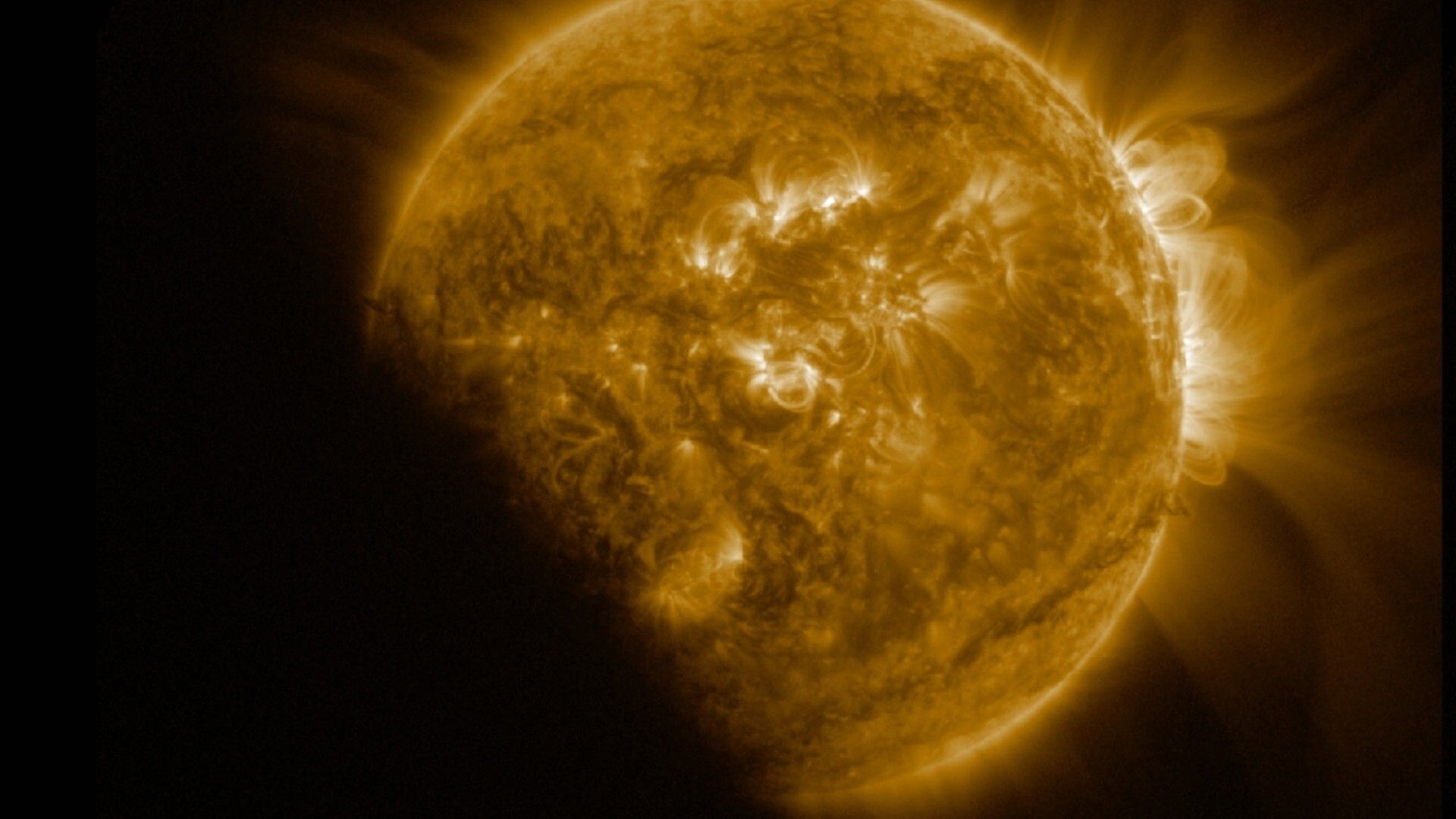
Massive Magnetic Engine Buried 16 Earths Deep Drives the Sun's Most Violent Storms
The findings could eventually aid in better predictions of space weather.
Sun storms are powered by a magnetic engine 16 Earths deep, study finds
Scientists have discovered that the powerful magnetic forces driving solar storms and sunspots originate from a layer surprisingly close to the sun's surface, roughly 20,000 miles deep, or about 16 times the diameter of Earth. This groundbreaking finding, published by an international team of researchers, challenges decades of conventional thinking that placed the sun's magnetic dynamo much deeper within the star's interior. Using advanced computational models and observational data, the team determined that the turbulent plasma churning in this relatively shallow region is responsible for generating the magnetic fields that produce solar flares, coronal mass ejections, and other forms of space weather.
For years, the prevailing theory held that the sun's magnetic activity was generated near the base of the convection zone, approximately 130,000 miles below the surface. However, the new study suggests that the magnetic engine sits in the outermost layers of the sun, where plasma density drops sharply and conditions are ripe for intense magnetic field generation. The researchers used sophisticated computer simulations to model the behavior of solar plasma and found that the shallow layer produced magnetic patterns that closely matched real-world observations of sunspot cycles and solar activity.
The implications of this discovery extend well beyond academic interest. Solar storms can have serious consequences for life on Earth, disrupting satellite communications, damaging power grids, and posing radiation risks to astronauts. By pinpointing the true origin of the sun's magnetic activity, scientists hope to develop more accurate models for predicting when and how intensely solar storms will strike. Improved space weather forecasting could give governments, utility companies, and space agencies critical lead time to protect infrastructure and personnel.
The research team emphasized that much work remains to fully understand the complex mechanics at play beneath the sun's surface. Future studies will aim to refine the computational models and incorporate additional observational data from solar monitoring missions. Still, the researchers expressed confidence that locating the sun's magnetic engine represents a major step forward in solar physics. As humanity becomes increasingly dependent on technology vulnerable to space weather, the ability to anticipate solar outbursts could prove invaluable in safeguarding modern civilization.