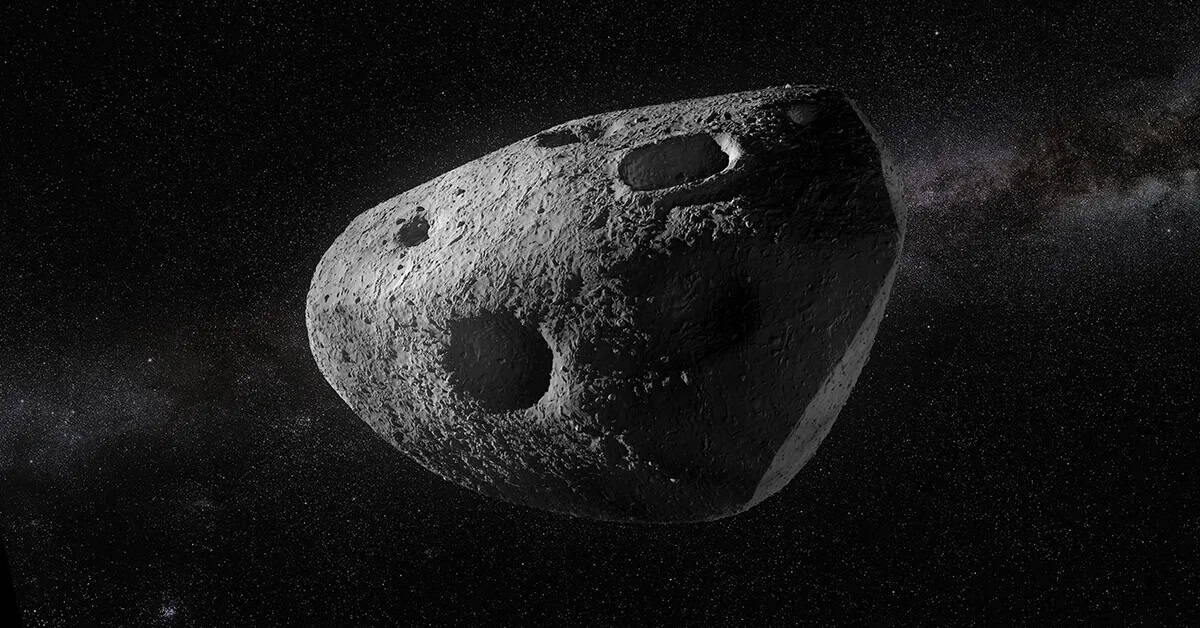
NASA Confirms 'God of Chaos' Asteroid Will Pass Closer to Earth Than Satellites in 2029
NASA confirms "God of Chaos" asteroid, Apophis, will streak past Earth in 2029. Discover why this record-breaking flyby is a safe, historic spectacle.
NASA has officially confirmed that the asteroid Apophis, nicknamed the 'God of Chaos,' will make an extraordinarily close pass by Earth on April 13, 2029, skimming closer than many geostationary satellites that orbit our planet. The flyby will mark one of the most significant asteroid approaches in recorded history, offering scientists and skywatchers an unprecedented opportunity to study a near-Earth object up close.
Apophis, which measures approximately 340 meters across, will pass within roughly 32,000 kilometers of Earth's surface. To put that in perspective, many weather and communications satellites orbit at altitudes of 35,786 kilometers, meaning the asteroid will actually dip below that orbital band. Despite the dramatic proximity, NASA has firmly ruled out any chance of impact, assuring the public that the event is entirely safe.
The close approach will be visible to the naked eye across parts of Europe, Africa, and western Asia, appearing as a fast-moving star-like object streaking across the night sky. Astronomers predict it will briefly become bright enough to be seen without any optical aids, a rare and spectacular occurrence for an asteroid of this size.
For the scientific community, the 2029 flyby represents a golden opportunity. Space agencies including NASA and the European Space Agency are already planning dedicated observation missions, and there is serious discussion about potentially landing a spacecraft on Apophis to study its composition and structure in real time. The data collected could prove invaluable for future planetary defense strategies.
Apophis was first discovered in 2004 and initially caused significant concern when early orbital calculations suggested a small but unsettling probability of impact in 2029. Subsequent observations and refined trajectory data eventually eliminated that possibility entirely, though the asteroid remained a subject of intense scientific interest due to its sheer size and proximity to Earth's orbital path.
Planetary defense experts say the event will also serve as a real-world test of humanity's asteroid monitoring and response capabilities. Tracking Apophis through its close pass will help scientists better understand how Earth's gravitational pull alters the asteroid's orbit, providing critical data for modeling future encounters with potentially hazardous objects.
The 2029 encounter is being described by many astronomers as a once-in-a-lifetime event. Whether viewed from a backyard or through a powerful telescope, the passage of Apophis is expected to captivate millions around the world and reignite public interest in space science and planetary defense.