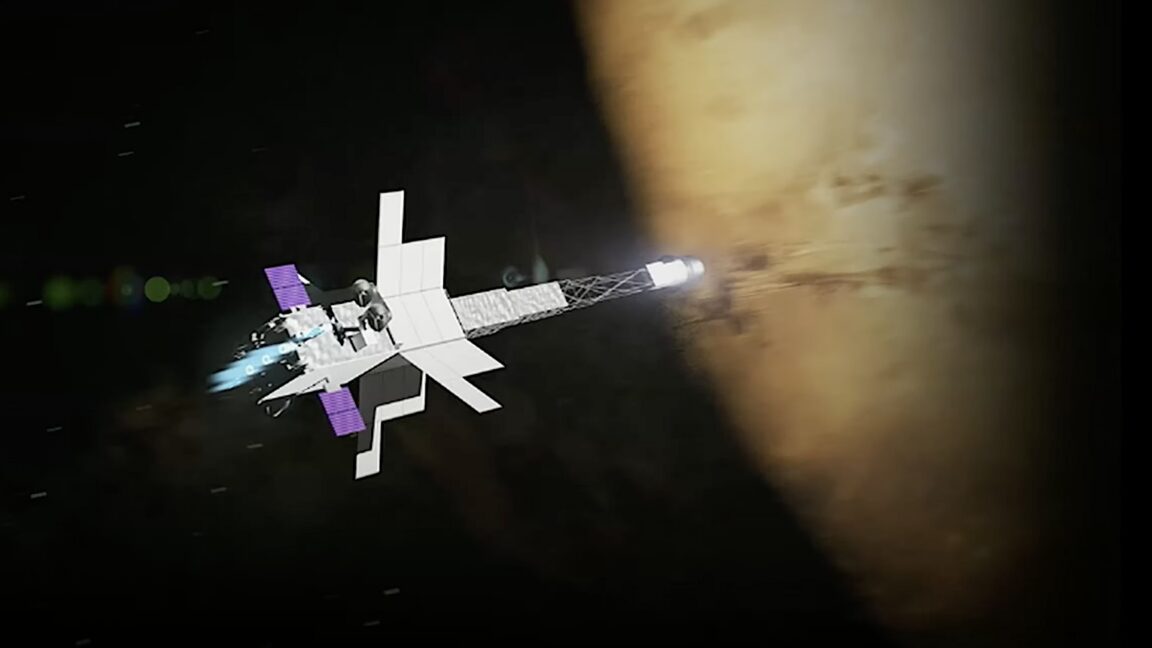
NASA Unveils Plan to Repurpose Gateway Station for Mars Mission Using Nuclear Propulsion
Only one US-built nuclear reactor has ever flown in space, and that was more than 60 years ago.
Here is NASA's plan for nuking Gateway and sending it to Mars
NASA has unveiled ambitious plans to repurpose its Gateway lunar space station for an eventual mission to Mars, powered by nuclear thermal propulsion technology that could revolutionize deep space travel. The agency's strategy involves equipping the orbital outpost with advanced nuclear reactors capable of generating the thrust needed to propel spacecraft across the vast distance between Earth and the Red Planet. This bold initiative marks a dramatic shift in how NASA envisions utilizing infrastructure originally designed for its Artemis moon program, potentially giving the Gateway station a second life far beyond lunar orbit.
The United States has a surprisingly limited history with nuclear power in space. Only one US-built nuclear reactor has ever flown in space, and that was more than 60 years ago. The SNAP-10A reactor launched in 1965 and operated for just 43 days in Earth orbit before a electrical component failure forced it to shut down. Since then, NASA has relied primarily on solar panels and radioisotope thermoelectric generators to power its missions, but agency officials acknowledge that these technologies are insufficient for the demands of crewed Mars missions, which require far greater energy output for both propulsion and life support systems.
Nuclear thermal propulsion offers significant advantages over conventional chemical rockets for deep space travel, potentially cutting the transit time to Mars nearly in half. By superheating a propellant such as liquid hydrogen through a nuclear fission reactor, these engines can achieve roughly twice the efficiency of the best chemical rockets available today. NASA has been working alongside the Defense Advanced Research Projects Agency on the DRACO program to develop and demonstrate nuclear thermal propulsion technology, with test flights anticipated within the coming years. Engineers believe this technology is essential for making crewed Mars missions practical and reducing astronaut exposure to harmful cosmic radiation during the long journey.
Despite the promising vision, significant technical and regulatory hurdles remain before nuclear-powered spacecraft become a reality. Building reactors that are compact, lightweight, and reliable enough for years-long space missions presents enormous engineering challenges, and launching nuclear material into space raises safety and political concerns that must be carefully addressed. NASA officials have emphasized that extensive ground testing and unmanned demonstrations will precede any crewed nuclear-powered missions. Nevertheless, the agency remains optimistic that by leveraging the Gateway platform and advancing nuclear propulsion capabilities, humanity could be on a trajectory to reach Mars within the next two decades.