NASA's Curiosity Rover Hits a Snag — and a Sharp Rock Might Be the Fix
If the wheel is too damaged, NASA has two maneuvers up its sleeve to snap it off: the "Twist and Shout Maneuver" and the "Pigeon Toe Maneuver".
NASA's Curiosity Rover Appears To Be In A Spot Of Trouble, And May Need A Sharp Rock To Deal With It
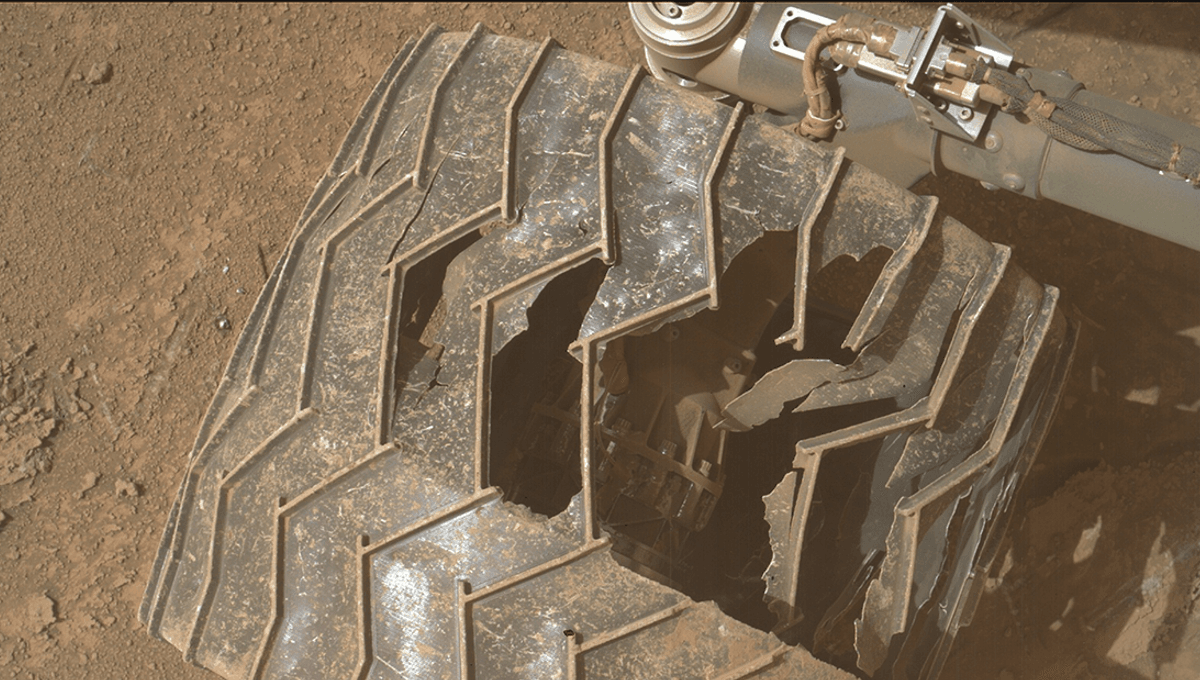
NASA's Curiosity rover, which has been exploring the surface of Mars since its landing in Gale Crater in August 2012, is facing a new mechanical challenge that has engineers back on Earth brainstorming creative solutions. One of the rover's six aluminum wheels has sustained significant damage over its years of traversing the harsh Martian terrain, with a large section of the wheel's skin peeling away and threatening to interfere with the rover's ability to drive safely. Mission planners are now considering an unconventional fix: deliberately driving the damaged wheel over a sharp rock to sever the loose piece of metal before it causes further problems.
The wear and tear on Curiosity's wheels has been a known concern for years. The thin aluminum wheels were designed to be lightweight, but the jagged, rocky landscape of Mars has taken a serious toll, punching holes and creating tears across the wheel surfaces. While some damage was anticipated, the current situation has escalated as a flap of metal has begun to curl outward, raising fears that it could snag on the rover's other components or dig into the Martian surface and impede movement. Engineers have been closely monitoring the situation through images sent back by the rover's cameras.
If the sharp rock approach fails or if the wheel damage proves too severe, NASA has developed two backup maneuvers to deal with the problem. The first, colorfully dubbed the "Twist and Shout Maneuver," involves rotating the damaged wheel back and forth repeatedly against the ground to stress the metal flap until it breaks free. The second option, known as the "Pigeon Toe Maneuver," would have the rover angle its wheels inward and drive in a way that creates a shearing force on the damaged section, effectively snapping it off. Both techniques have been tested in simulations on Earth using replica rovers and terrain designed to mimic Martian conditions.
Despite the challenges, NASA remains confident that Curiosity can continue its scientific mission for the foreseeable future. The rover has already far exceeded its original two-year mission timeline and continues to deliver invaluable data about the geology and climate history of Mars. Engineers have adapted driving strategies over the years to minimize further wheel damage, including selecting smoother routes and driving the rover backward when possible to distribute wear more evenly. The team's resourcefulness in addressing problems from millions of miles away remains one of the most remarkable aspects of the ongoing mission, proving that ingenuity is just as important as engineering when it comes to exploring another planet.