NASA's Webb and Hubble Deliver the Most Detailed Look at Saturn Ever
NASA’s Webb and Hubble Space Telescopes have teamed up to capture new views of Saturn, revealing the planet in strikingly different ways.
NASA Webb, Hubble Share Most Comprehensive View of Saturn to Date
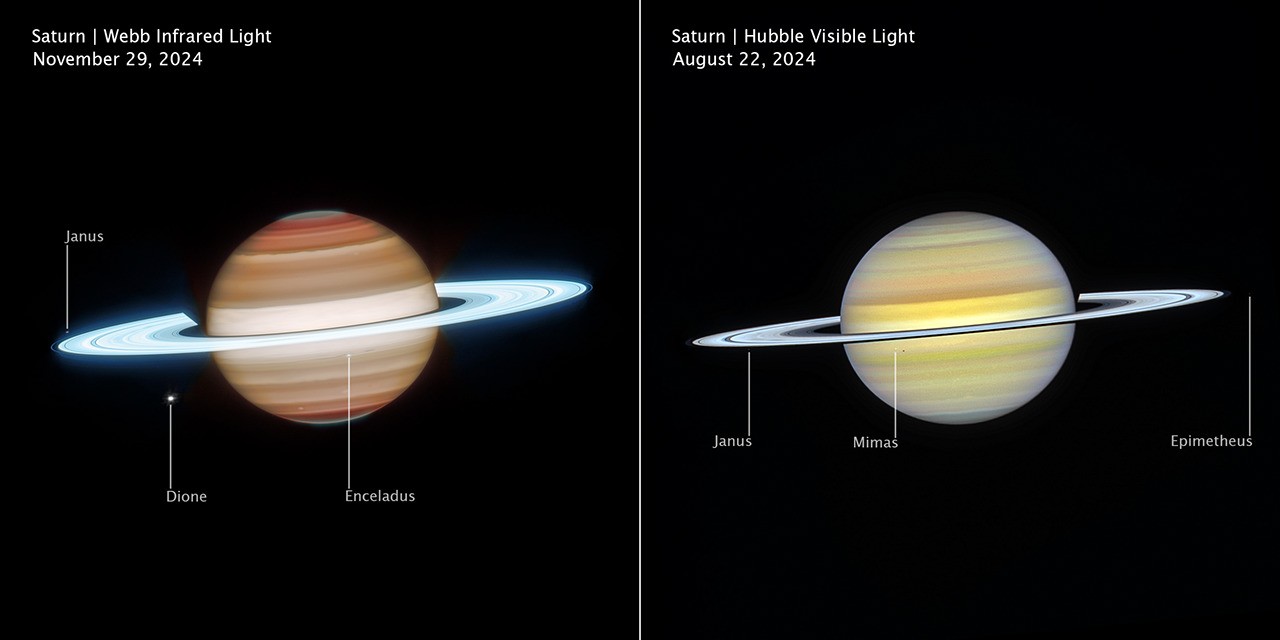
NASA's James Webb Space Telescope and Hubble Space Telescope have joined forces to deliver the most detailed and comprehensive observations of Saturn ever produced, revealing the ringed planet in breathtaking new detail. The collaborative effort showcases Saturn in strikingly different wavelengths of light, offering scientists and the public alike an unprecedented look at the gas giant's complex atmosphere, iconic ring system, and dynamic weather patterns. The images were released by NASA as part of an ongoing effort to leverage both flagship observatories for complementary planetary science.
Hubble captured Saturn in visible light, highlighting the planet's familiar golden hues and the subtle banding of its cloud layers with remarkable clarity. The telescope's sharp optical capabilities allowed researchers to track storm systems and seasonal changes in Saturn's atmosphere, continuing a legacy of planetary monitoring that Hubble has maintained for decades. Meanwhile, details in the ring structure, including the Cassini Division and fainter inner rings, were rendered with impressive precision, giving astronomers fresh data to study the composition and behavior of the icy particles that make up the rings.
Webb's infrared instruments provided an entirely different perspective, peering beneath Saturn's upper cloud deck to reveal thermal patterns and atmospheric chemistry invisible to the human eye. In Webb's view, the planet takes on a dramatically altered appearance, with methane absorption darkening much of the globe while the rings remain brilliantly reflective. These infrared observations are helping scientists better understand the distribution of gases and aerosols at various altitudes in Saturn's atmosphere, as well as the composition of the ring material itself.
Together, the two telescopes offer a powerful combination that no single instrument could achieve alone. NASA scientists say the paired observations will serve as a benchmark for future studies of Saturn and other giant planets in our solar system and beyond. The collaboration underscores NASA's strategy of using its space telescope fleet in concert to maximize scientific return, and researchers expect continued joint observations to yield even deeper insights into the processes shaping one of our solar system's most iconic worlds.