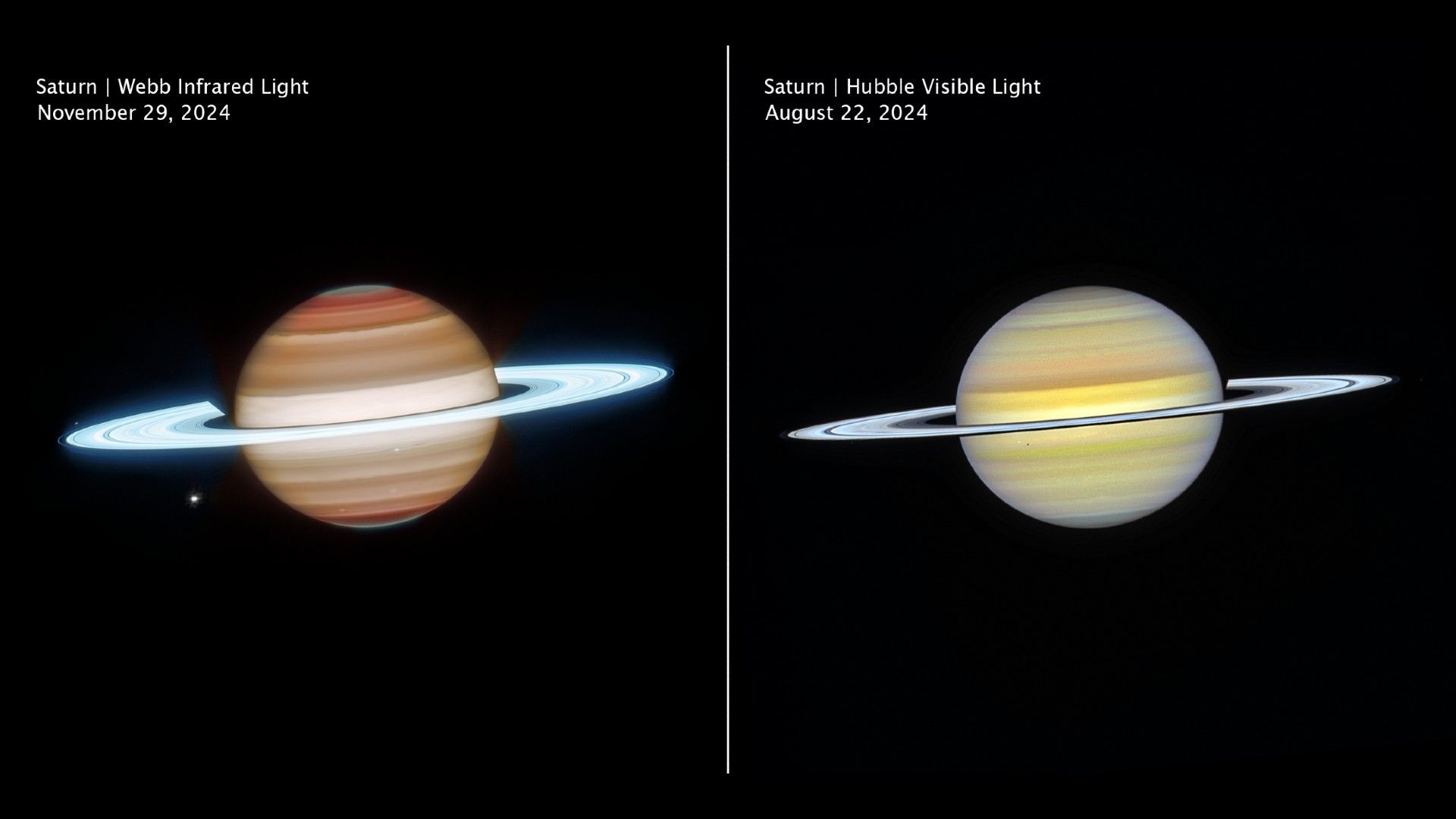
NASA's Webb and Hubble Join Forces to Capture Saturn Like Never Before
Combined observations offer the most detailed portrait of the ringed planet to date.
Incredible new NASA images reveal Saturn in a new light — and it's all thanks to a telescope team-up from Webb and Hubble
NASA has released a stunning new collection of images of Saturn that scientists are calling the most detailed portrait of the ringed planet ever produced. The breathtaking views were made possible by combining observations from two of the agency's most powerful space telescopes — the James Webb Space Telescope and the Hubble Space Telescope. By merging data captured across infrared and visible light wavelengths, researchers have been able to reveal features of Saturn's atmosphere and ring system that have never been seen with such clarity before.
The collaboration between Webb and Hubble allowed scientists to take advantage of each telescope's unique strengths. Hubble, which has been orbiting Earth since 1990, captured sharp visible-light details of Saturn's banded cloud layers and iconic rings. Meanwhile, Webb's powerful infrared instruments peered beneath the planet's upper atmosphere, uncovering hidden storm systems and temperature variations that are invisible to the naked eye. Together, the two datasets were layered to create a comprehensive and richly detailed composite view of the gas giant.
Scientists say the combined observations have already yielded new insights into Saturn's complex weather patterns and the composition of its rings. Researchers noted subtle seasonal changes in the planet's northern and southern hemispheres, as well as previously undetected variations in the density and structure of the inner rings. These findings could reshape our understanding of how giant planets evolve and interact with their surrounding ring systems over time.
The release has generated excitement across the scientific community and among space enthusiasts worldwide. NASA officials emphasized that the Webb-Hubble partnership represents a new era of planetary science, in which complementary telescopes work in tandem to unlock mysteries that neither could solve alone. With more joint observations planned in the coming months, researchers are optimistic that even greater discoveries about Saturn and other planets in our solar system are just around the corner.