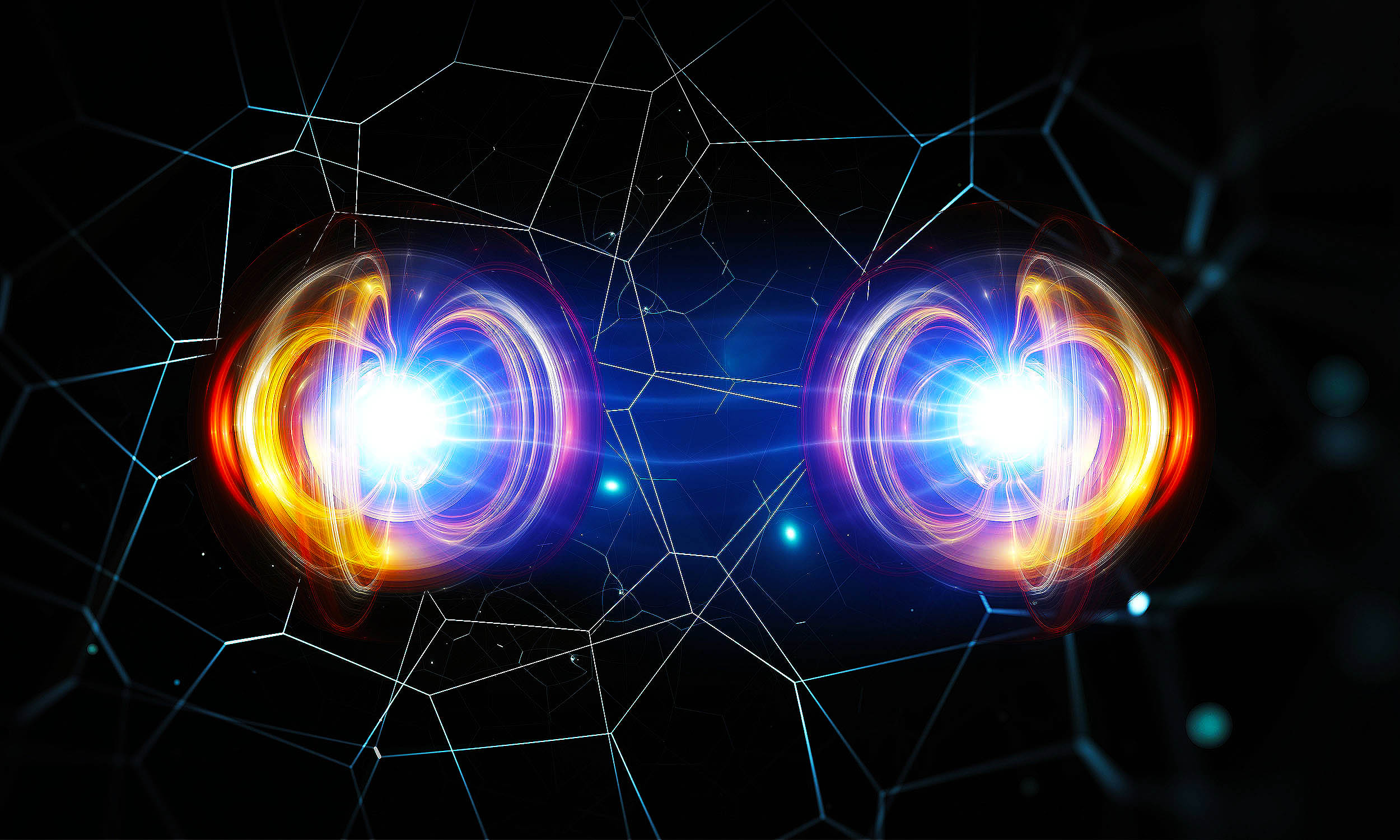
Scientists Measure Quantum Entanglement Speed for the First Time — and It Defies Comprehension
Quantum entanglement happens when two particles become interconnected and share a single state. Scientists have measured how fast it happens.
Quantum entanglement speed is measured for the first time - it's too fast to comprehend
In a groundbreaking achievement that pushes the boundaries of modern physics, scientists have for the first time measured the speed at which quantum entanglement occurs between two particles. Quantum entanglement, one of the most mysterious phenomena in the universe, happens when two particles become interconnected and share a single quantum state, meaning that any change to one particle is instantly reflected in the other regardless of the distance between them. Researchers have now determined that this interaction occurs at a speed that is at least 10,000 times faster than the speed of light, a figure so staggering that it challenges our fundamental understanding of how information can travel through the cosmos.
The experiment was conducted by a team of physicists who designed an intricate setup to isolate entangled photon pairs and measure the timing of correlated state changes with extraordinary precision. Using advanced detectors capable of registering events at the femtosecond scale, the researchers were able to narrow down the speed of the entanglement interaction to a lower bound that dwarfs any known physical speed. While Einstein famously referred to entanglement as "spooky action at a distance" and expressed deep skepticism about its implications, this new measurement confirms that the phenomenon operates on a scale that is virtually instantaneous.
Despite the extraordinary speed measured, scientists are quick to point out that quantum entanglement cannot be used to transmit usable information faster than light, preserving the core tenets of Einstein's theory of relativity. The correlations between entangled particles only become meaningful when measurements from both sides are compared through conventional communication channels. This distinction is critical, as it means the discovery does not open the door to faster-than-light communication or time-travel paradoxes, but it does deepen our understanding of the non-local nature of quantum mechanics.
The findings have generated enormous excitement across the scientific community, with researchers suggesting the results could have profound implications for the development of quantum computing, quantum cryptography, and secure communications networks. By better understanding the mechanics of entanglement, engineers may be able to build more reliable quantum systems that exploit these instantaneous correlations for practical applications. As physicists continue to probe the mysteries of the quantum world, this measurement stands as a remarkable milestone, reminding us that the universe operates according to rules that remain breathtakingly beyond human intuition.