The Spot on Earth Where Gravity Is Measurably Weaker Than Anywhere Else
There are a number of places around the world where acceleration due to gravity doesn't match up to the familiar 9.81 meters per second squared you remember from school. But why?
Most of us learned in school that the acceleration due to gravity on Earth's surface is a neat 9.81 meters per second squared. It turns out, however, that this figure is more of a useful approximation than a universal constant — and the variation from place to place is more significant than you might expect.
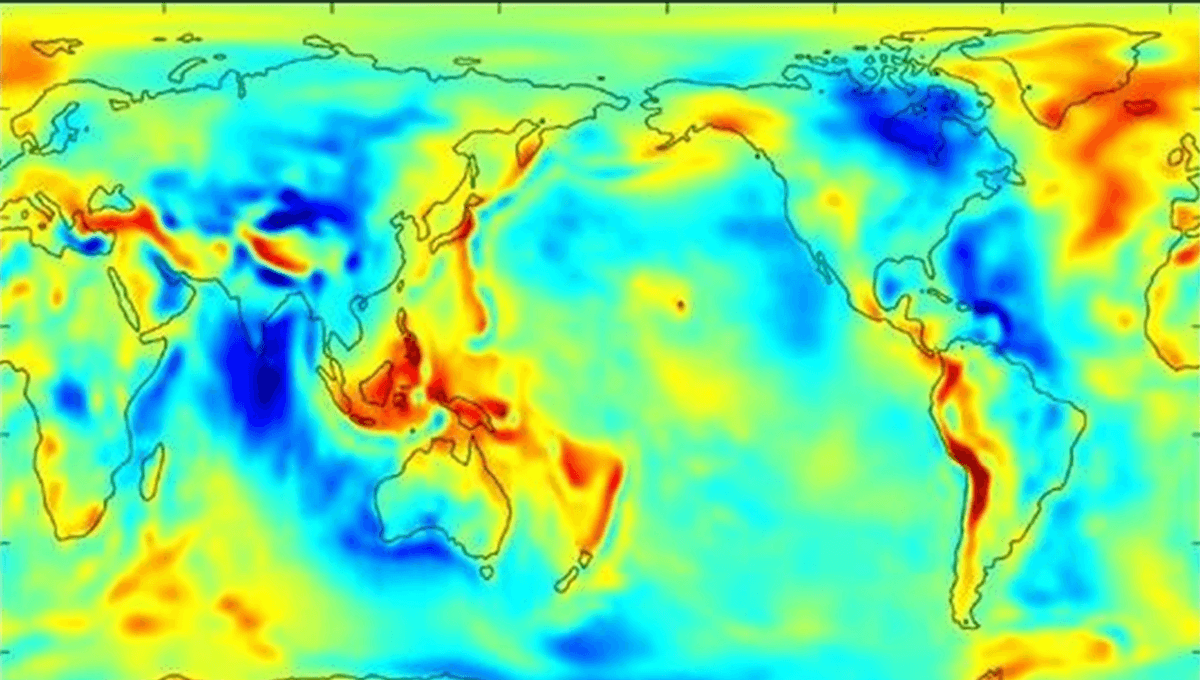
The Hudson Bay region of Canada holds the distinction of having some of the weakest gravitational pull measured anywhere on Earth's surface. Scientists have puzzled over this anomaly for decades, and the explanations they have uncovered reveal just how dynamic and complex our planet truly is.
One major contributing factor dates back to the last Ice Age. Roughly 20,000 years ago, a colossal ice sheet — sometimes called the Laurentide Ice Sheet — blanketed much of northern North America. The sheer weight of this ice pushed the underlying mantle rock downward. Although the ice melted thousands of years ago, the mantle has not fully rebounded, meaning there is simply less mass beneath that region than elsewhere, resulting in a weaker gravitational pull.
A second explanation involves the movement of tectonic plates and the circulation of molten rock deep within the Earth's mantle. Convection currents drag material downward in certain regions, reducing the local density and therefore the gravitational force experienced at the surface above.
Gravity also varies with altitude and latitude. Because Earth is not a perfect sphere but rather an oblate spheroid — slightly flattened at the poles and bulging at the equator — someone standing at the equator is farther from the planet's center of mass than someone standing at a pole. This means gravitational acceleration is slightly weaker at the equator and strongest near the poles.
These differences, while small in absolute terms, have real-world implications. Satellite orbits must account for gravitational anomalies to maintain precision. Space agencies and geodesists use instruments called gravimeters to map the Earth's gravitational field in extraordinary detail, producing models that inform everything from GPS accuracy to our understanding of climate change through the monitoring of ice sheet loss.
Far from being a simple constant, gravity is a living reflection of Earth's interior structure, its geological history, and its ongoing evolution. The weak spot over Hudson Bay is a reminder that the ground beneath our feet is far more complex — and far more fascinating — than any textbook figure can capture.