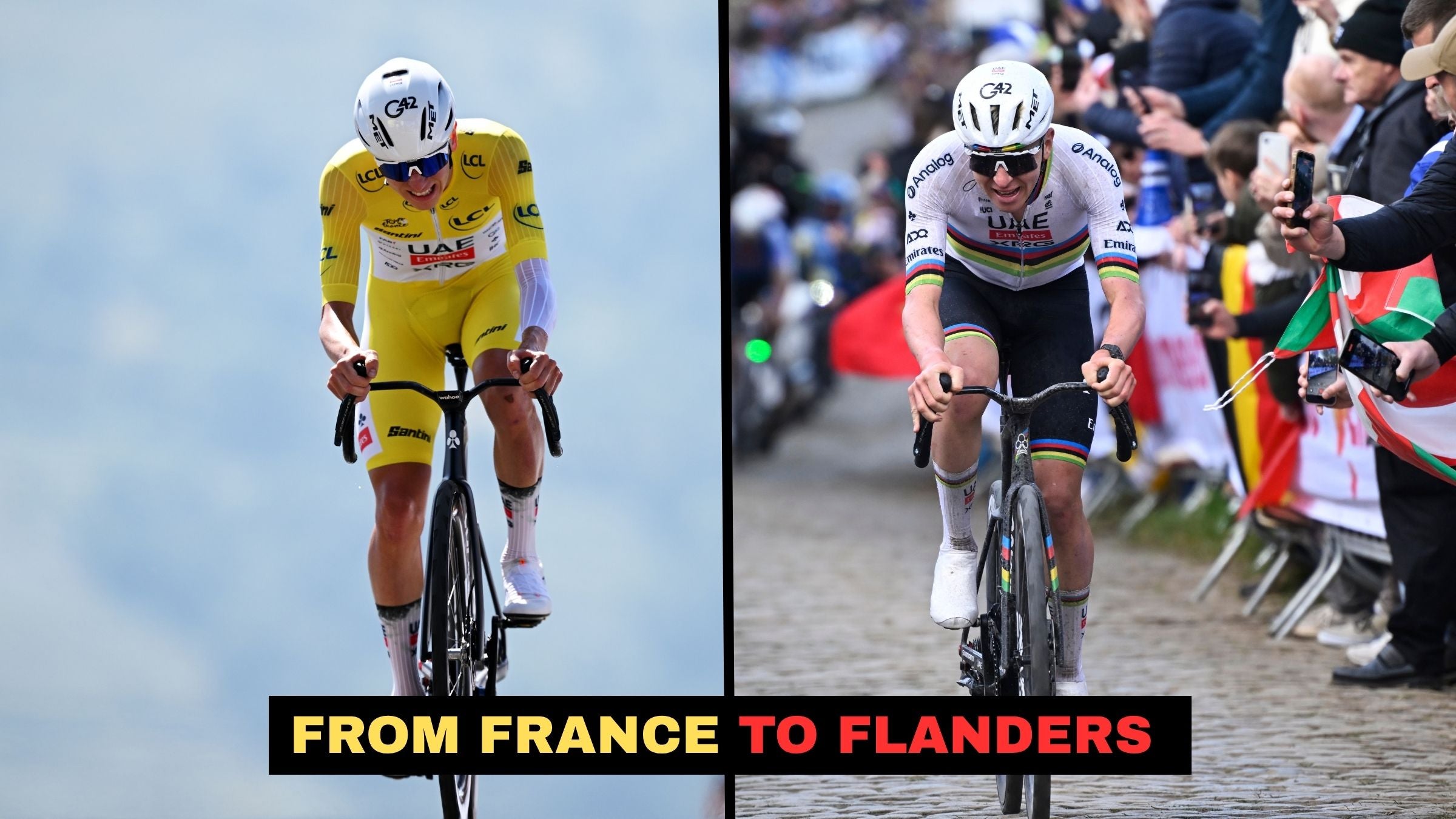
Pogačar's Seasonal Body Transformation: The Science Behind Bulking for Cobbles and Cutting for Climbs
Pogačar packs on weight and power over winter in a subtle transformation that allows decimation of the Tour of Flanders and the Tour de France.
Tadej Pogačar has quietly mastered one of the most demanding physical transformations in professional sport, deliberately adding roughly five pounds of raw muscle each winter before methodically shedding that weight ahead of the grand tour season. It is a calculated cycle of bulk and cut that underpins his seemingly impossible ability to dominate both the cobbled classics of spring and the Alpine stages of the Tour de France.
The Slovenian superstar arrives at races like the Tour of Flanders carrying additional upper-body mass and raw power that allows him to generate enormous wattage across the brutal pavé sections of northern Europe. That extra muscle translates directly into the kind of explosive force required to power through the Kapelmuur or sprint out of a lead group on the Oude Kwaremont without cracking under the physical punishment the cobbles inflict.
As the calendar turns toward May and June, Pogačar and his team at UAE Team Emirates begin a meticulous process of trimming that winter mass, dialing in his power-to-weight ratio with surgical precision. Every kilogram shed at this stage represents seconds saved on long Alpine ascents, where the mathematics of watts per kilogram ruthlessly separate the contenders from the pretenders.
The transformation is carefully managed by team nutritionists, coaches, and sports scientists who monitor Pogačar's body composition, training load, and recovery metrics in real time. Far from an improvised diet or a casual adjustment in training volume, the process reflects years of accumulated data and a deep understanding of what his body demands at each point of the racing calendar.
What makes Pogačar's case remarkable is not just the physiological discipline involved but the speed and consistency with which he executes the shift. While most elite riders choose to specialise — committing either to the classics or to stage racing — Pogačar has used this seasonal body management strategy to position himself as perhaps the most versatile rider in the modern peloton.
His 2024 season offered the most compelling evidence yet of the strategy's effectiveness. Pogačar demolished the field at the Tour of Flanders before going on to deliver a Tour de France performance widely regarded as one of the greatest in the race's history, winning multiple mountain stages with an authority that left rivals visibly demoralised. The dual dominance was no accident — it was the product of a physique engineered for two entirely different demands.
For the sport of cycling, Pogačar's approach is beginning to reshape how teams and coaches think about periodisation, nutrition, and athlete development. His willingness to deliberately alter his body composition across a season challenges long-held assumptions about what a classics rider or a climber should look like, suggesting that the future of elite cycling may belong to those bold enough to be both.